

- This event has passed.
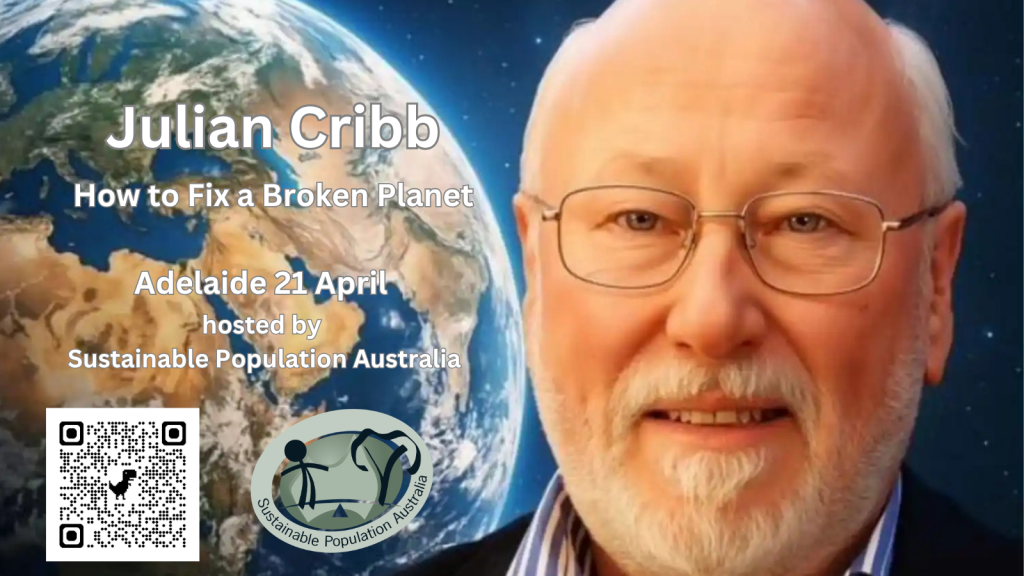
How to Fix a Broken Planet with Julian Cribb
April 21 @ 6:30 pm - 8:30 pm
$5
In-person and livestream. Don’t miss this conversation. Get your tickets TODAY from Humanitix
Where When How
The event is available to watch in person or online. More information at Humanitix.
The venue is upstairs at The Duke of Brunswick Hotel, 207 Gilbert St, Adelaide 5000. Arrive early and buy yourself dinner before or a drink at pub prices before coming upstairs.
Brought to you by the SA/NT Branch of Sustainable Population Australia www.population.org.au
From 6.45pm for 7.00pm. Q&A closes at approximately 8.15pm SA Time
Tuesday April 21, 2026, 07:00 PM Adelaide, Australia
Live stream will commence approximately 5-10mins prior to 7.00pm.
Click here to view => https://digiflix.com.au/live-streams/fixing-a-broken-planet/
About the Presenter
Julian Cribb AM is an Australian author and science communicator.
The Earth system that sustains human and all life is breaking down, due to ten massive threats that are the direct result of human activity; our excessive numbers, over-consumption and over-pollution. The combination of these threats poses the gravest emergency in the million-year story of our species. There is no plan to prevent and mitigate such a catastrophe – or even an agreement to save ourselves.
The Council for the Human Future has proposed we adopt an Earth System Treaty – a global legal accord, to be negotiated, signed and ratified by all the nations and citizens of the Earth, under the UN umbrella, as an essential first step in addressing the human emergency.
Julian Cribb is co-founder for the Council for the Human Future, Surviving the 21st Century
Julian Cribb’s career includes appointments as scientific editor for The Australian newspaper, director of national awareness for CSIRO, editor of several newspapers, member of numerous scientific boards and advisory panels, and president of national professional bodies for agricultural journalism and science communication.
His published work includes over 9000 articles, 3000 science media releases and 12 books. His focus is the existential risk faced by humanity for which he has received many awards.